

How to turn the productivity of your best AI users into a capability your whole organization can run on, built on tested, reusable skills and powered by Claude
Beyond AI Adoption: The Next Competitive Advantage Is Organizational Intelligence
Why the companies that win with AI won't simply have better tools they'll build better ways to capture, share, and improve what their people learn.
Every executive conversation about AI eventually reaches the same milestone. The pilots worked. Employees are using generative AI. Productivity is improving in pockets across the business. Yet the expected enterprise-wide impact never fully arrives. The problem is rarely the model, the platform, or the budget. The real challenge is that the knowledge created by AI remains personal instead of becoming organizational.
Walk through any company today and you'll find a handful of employees who have quietly transformed the way they work. They've refined prompts, built repeatable workflows, learned how to review outputs, and discovered where AI adds value and where it doesn't. Their experience represents a growing body of intellectual capital. Unfortunately, most of it lives inside personal chat histories, documents, and notebooks.
Organizations have spent decades building systems to manage customer data, financial information, and documents. Few have asked an equally important question: How do we manage AI knowledge?
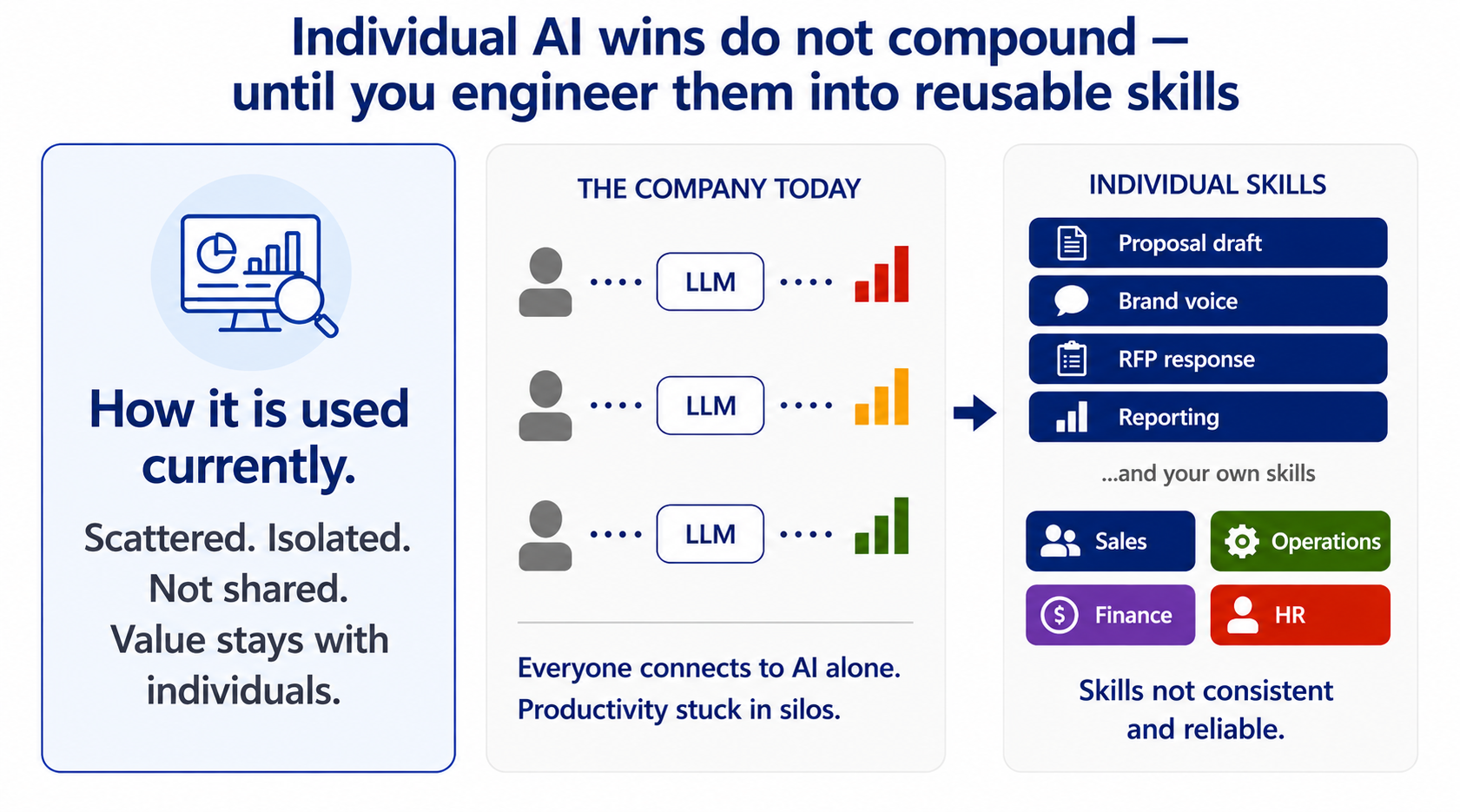
Access to AI has become widespread. Competitive advantage now comes from how effectively organizations turn individual success into repeatable business capability.
· Capture what your best people have learned.
· Standardize proven workflows.
· Make expertise available across teams.
· Continuously improve and govern those workflows.
Every undocumented prompt, isolated workflow, and personal automation creates what we call AI knowledge debt. It delivers value to one person today but becomes difficult to maintain, improve, or reuse tomorrow. As more employees create their own ways of working, organizations face inconsistent quality, duplicated effort, and growing governance challenges.
The shift requires a different mindset. Instead of treating prompts as personal shortcuts, treat successful AI workflows as business assets. Document them .Test them. Improve them. Give them ownership. Make them available to the people who need them.
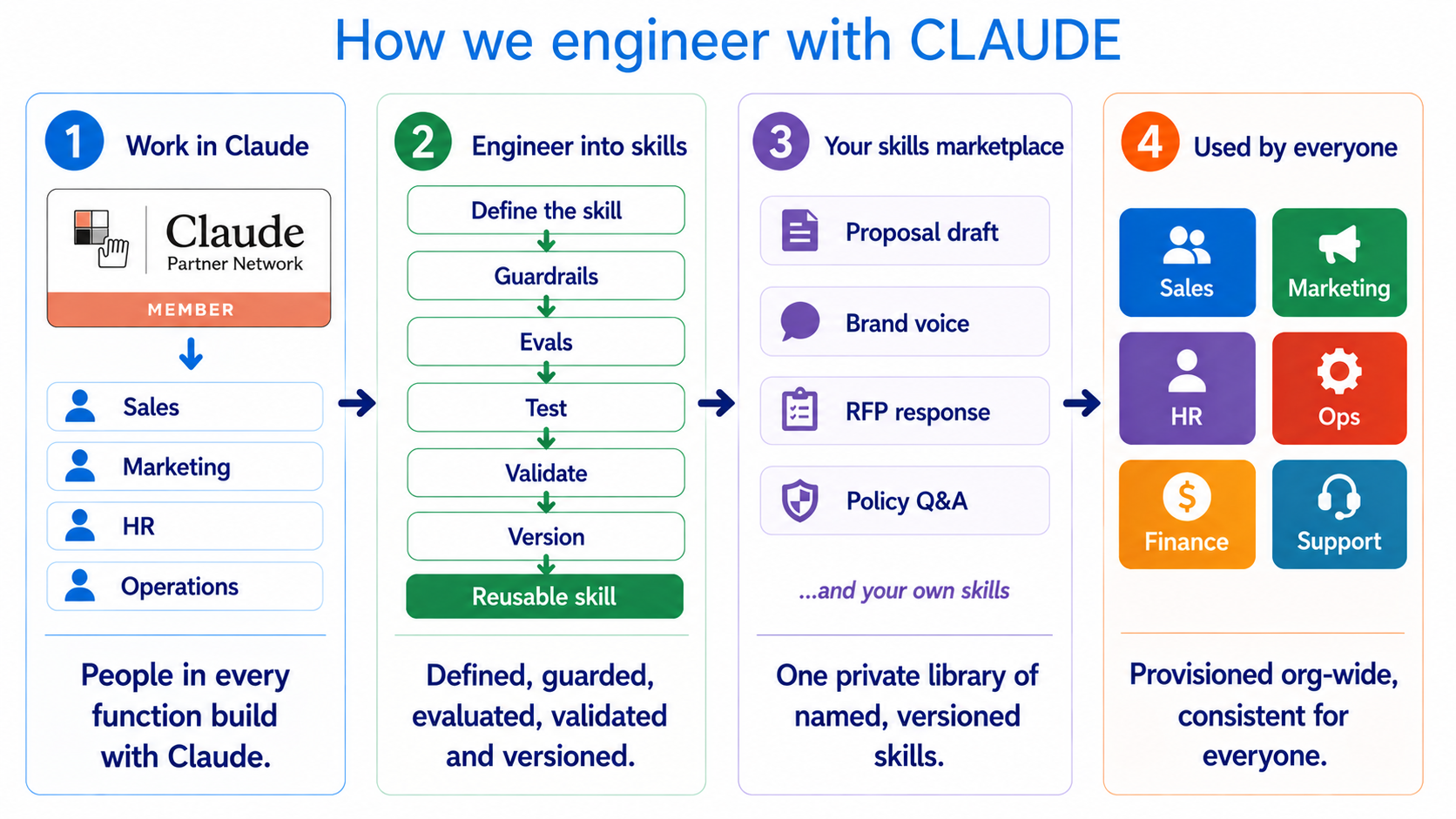
An AI Skills Marketplace is not simply a library of prompts. It is a governed collection of reusable business capabilities. Each skill combines instructions, business rules, context, review guidance, and version control so that employees can produce consistent results without starting from scratch.
· Clear purpose and business outcome
· Embedded business rules and guardrails
· Version history and ownership
· Validation before broad adoption
· Continuous improvement based on feedback
When knowledge is centralized, organizations gain visibility. Leaders know which workflows are being used, which versions are current, and where human review is required. Governance becomes part of everyday work instead of an afterthought.
At Value Global, we believed this approach had to prove itself internally before we recommended it to clients. We implemented reusable AI skills across marketing, sales, and delivery, capturing repeatable processes and improving them over time. Our experience reinforced a simple lesson: technology accelerates work, but structured knowledge scales it. As a Claude Services Partner, we use Claude as the foundation for this approach, while our primary value lies in helping organizations capture, organize, govern, and operationalize what their teams already know.
Enterprise transformation doesn't start with hundreds of AI use cases. It starts with one workflow that matters.
· Choose a repetitive business process.
· Identify the people already performing it well with AI.
· Capture the workflow and the decision rules behind it.
· Validate and refine it.
· Make it available across the organization.
· Measure adoption and improve continuously.
· Instead of asking how many employees use AI, ask how much organizational knowledge has become reusable.
· Instead of counting prompts, measure repeatable business capabilities.
· Instead of celebrating isolated productivity gains, track how quickly best practices spread across the organization
Most organizations are still thinking about AI as software. The companies that create lasting advantage will treat AI knowledge as strategic intellectual property. They will build systems that capture expertise, improve it over time, and make it available wherever work happens.
The next competitive advantage will not belong to the organizations with the most sophisticated prompts. It will belong to those that transform individual expertise into an organizational capability.
Why Value Global
Value Global helps organizations move beyond AI experimentation by building governed, reusable AI capabilities that support long-term business outcomes. Through enterprise AI consulting, automation, and private AI solutions, we help clients scale knowledge, not just technology.


