

A year ago, the question in most engineering teams was whether AI could write usable code. That question is settled. It can. The harder question now is this: when a machine writes most of the code, can you still trust what ships, and can you still say who is accountable for it?
That is the real story of AI in software development. It isn’t about typing faster. It’s about what happens to everything around the code. There are two ways this can play out. They may look similar on day one, but they lead to very different outcomes.
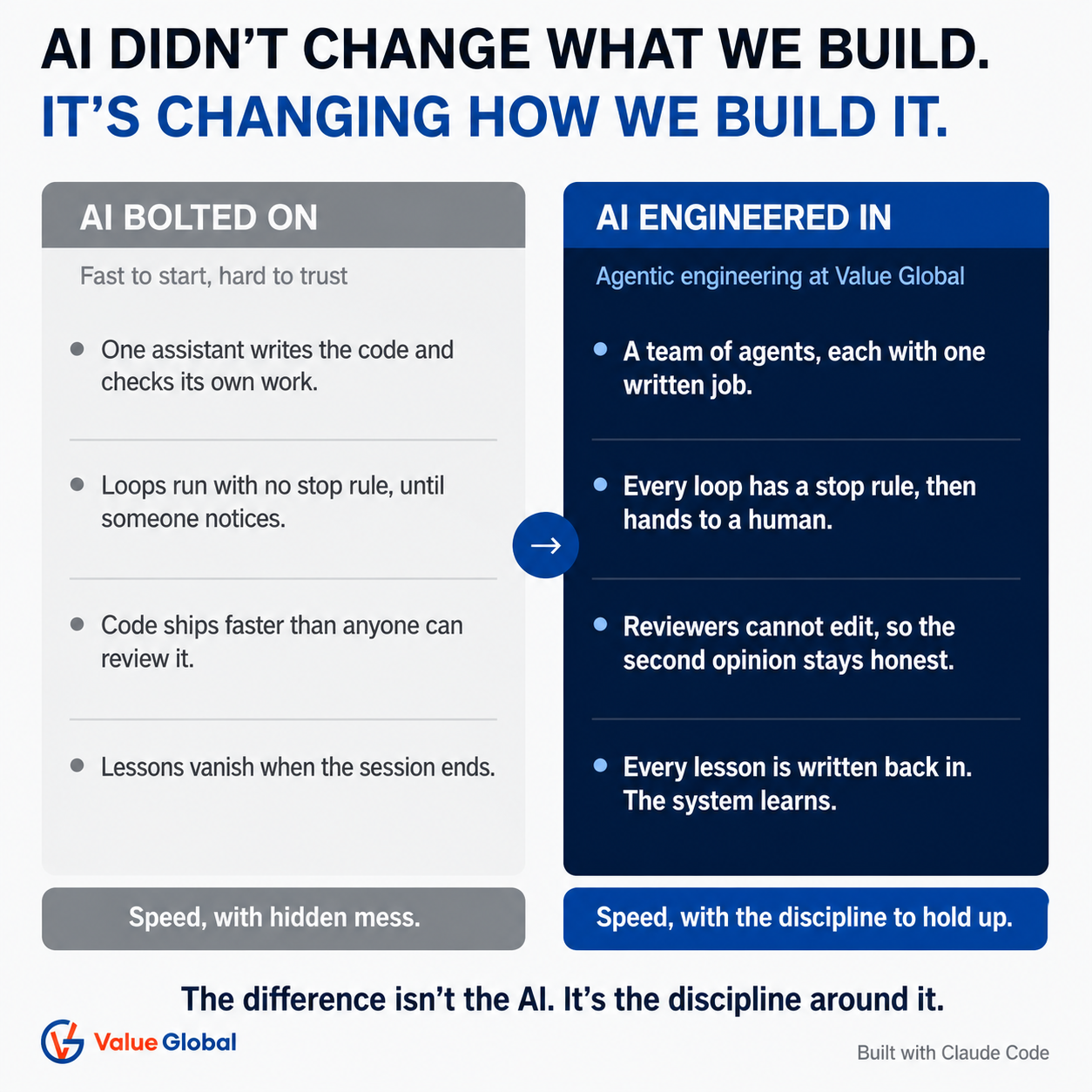
Most teams start with AI the same way. They keep their existing process and add an assistant on top. A developer describes a task, the assistant writes the code, the developer skims it, and everyone moves on. Output increases right away, which feels like progress.
The cost shows up later, and it’s easy to miss at first. Code ships faster than anyone can properly review it. Often, the same assistant that writes the code is also asked to review it, so there’s no real second opinion.
When a session ends, whatever the assistant learned is gone, and the next task starts from scratch. Speed goes up, but so does a quiet kind of debt that no one planned to pay down.
We call this pattern AI bolted on. It gets you moving on day one, but it becomes harder to trust by month three. It’s also where much of the industry is today.
The alternative isn’t a better prompt. It’s a different way of working. Instead of one assistant doing everything, you use a group of specialized agents much like a small team, with defined roles, rules, and a person in charge. In plain terms, four things change.
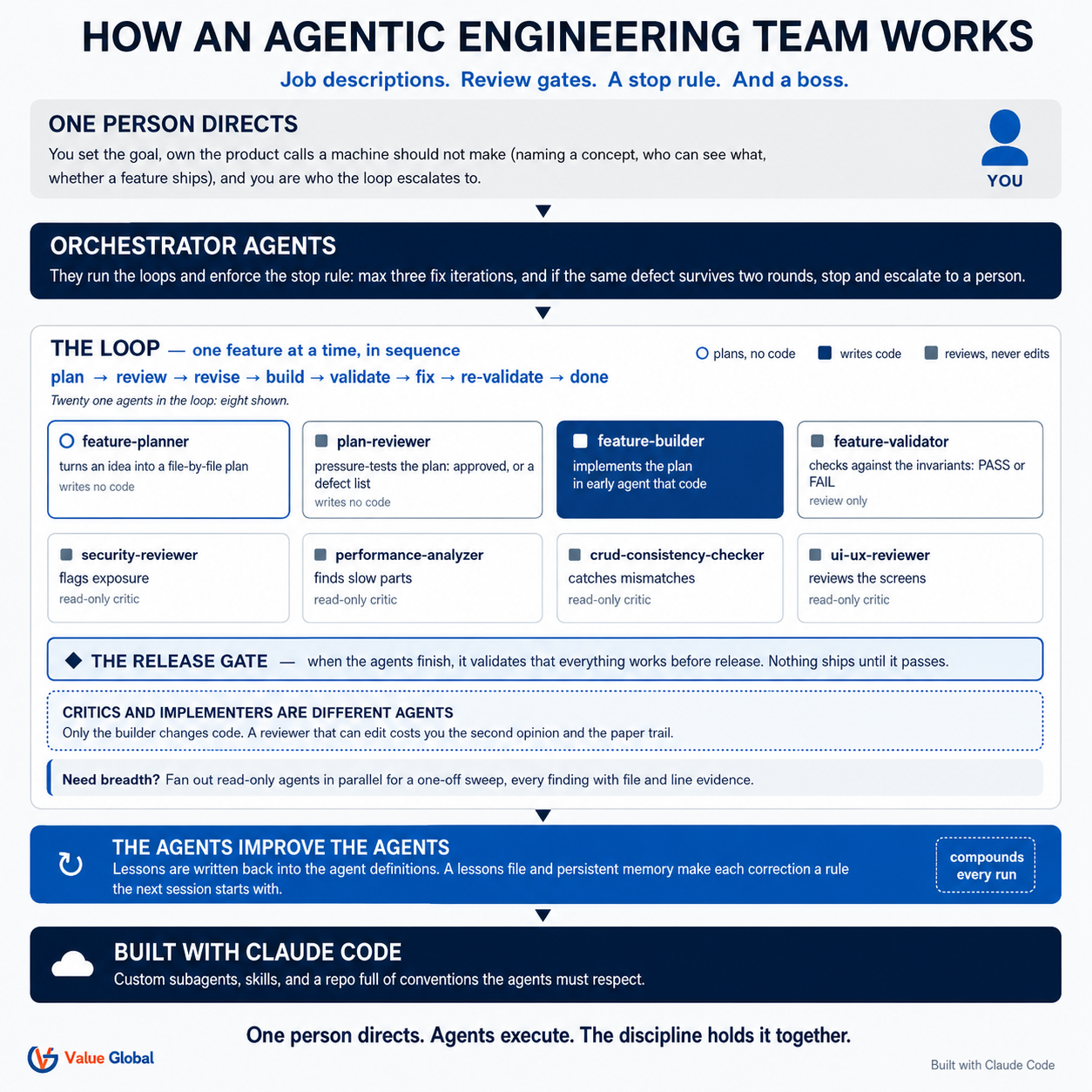
▪️First, every agent has a written job. Not a clever prompt, a job description: what the agent owns, what it must never touch, and exactly what its output should look like. It may sound unglamorous, but this is where much of the quality comes from.
▪️Second, the critic never holds the pen. Only the builder can write code, while the agents reviewing it cannot change what they find. This may sound like a small distinction, but it’s one of the most important rules. If a reviewer can also edit, it can quietly fix what it finds. You lose the paper trail and the value of an independent review. Separating the maker from the checker keeps the review honest. Two agents built on the same model aren’t fully independent, so this is a structural check, not a statistical one. They can still share the same blind spot. The separation gives you a different role working in a different context, which helps catch issues. For decisions that carry real risk, a final independent review still belongs with a person.
▪️Third, every loop has a stopping rule. Left alone, an agent can go in circles or declare a job finished when it isn’t. So the work runs through a loop driven by orchestrator agents: plan, review, revise, build, validate, then fix and validate again. Nothing passes the release gate while a validator still reports a critical finding. The orchestrators also have a hard limit: no more than three fix attempts. If the same defect survives two rounds, they stop and hand the work to a person.
A repeating failure usually means there’s a human decision hiding inside what looked like a technical task.
▪️Fourth, the system learns. When someone corrects the team, that correction is added to the agents’ instructions instead of being left in a chat log that disappears. Over time, the agents get better at working with that specific codebase, not just at coding in general.
Underneath all of this is one line we don’t cross: agents surface decisions; people make them. Naming a concept, deciding who can see what, or deciding whether a feature is ready to ship—those decisions never belong to a machine.
None of these ideas are exotic. They’re the disciplines good teams have always used: clear ownership, independent review, a definition of done, and lessons that outlive the person who learned them. What’s new is that these same disciplines now need to apply to software that is largely written by machines.
The teams that struggle are usually the ones that dropped these disciplines as soon as AI made it possible to move faster without them.
Our Director of Development, Bhaskar, is running this approach on a live platform build. The clearest example is an audit he would never have scheduled manually.
▪️He pointed a group of agents at every screen in the platform, with each agent checking its assigned area against a shared checklist. They ran in parallel. In a single afternoon, they produced one consolidated report covering every page.
▪️Most of what they found was routine housekeeping. But two findings were real problems. One screen could have exposed sensitive financial information to people who shouldn’t have had access because it reused a component protected by a weaker permission check.
▪️Another screen displayed money in the wrong currency because the symbol was hard-coded instead of being read from the record. A manual review of that scope would be a multi-week project that few teams would put on the calendar. Here, it took an afternoon, including the time spent challenging and validating the results.
▪️ The important part isn’t the speed. It’s that the agents were designed to disagree and be checked. When two agents flagged something a third had missed, a direct check determined who was right. No finding is acted on until a direct check confirms it. Verification is part of the method, which is why the team could act on the results.
A fair concern is that this replaces engineers. In practice, it moves them up the value chain. When agents handle routine writing and tedious checks, scarce human time can go where judgment matters most: architecture, security, product decisions, and the review of anything involving money, access, or customer data.
The senior engineer stops being a faster typist. They design the system the agents work within, set the rules those agents follow, and own the decisions the agents can’t make. That’s a better use of experienced talent, not a smaller role.
Every leader we talk to is adding AI to the development lifecycle right now. The pressure to move faster is real, and AI can significantly compress the build.
But there’s a catch that rarely makes the pitch. Speed moves the bottleneck downstream. When code is generated faster than it can be reviewed, review becomes the constraint. Without a redesigned process, quality can slip.
For a transformation program, that changes the economics in a specific way. The build phase, which used to dominate the timeline, gets shorter. The work that remains becomes more important: discovery, architecture, verification, and the human judgment required at the edges.
Teams that understand this move more effort upstream and protect time for it. Teams that don’t simply build the wrong thing faster. The savings are real, but they come from redesigning the process, not from pointing AI at the old one.
That’s why the discipline matters more than the tool. The teams that keep getting value from AI aren’t necessarily the ones with the best model or the cleverest prompt. They’re the ones that rebuilt their process so speed and trust can rise together: clear roles, an honest check, a defined stopping point, and a system that learns.
The tool is becoming a commodity. The discipline around it is what makes the difference. This is the approach Value Global has built, and it’s why we get more from AI in delivery than a generic bolt-on approach.
Where this stands today
It would be all too simple to claim this is finished and settled. It isn’t, and pretending otherwise would be the wrong way to earn trust. Agentic engineering is a practice we’re actively developing. Some of it is running today on real work, while other parts are still being validated.
We’re moving deliberately, adding a control before we grant more autonomy and measuring as we go. That caution isn’t a weakness in the approach. It is the approach.
If AI is already writing code inside your organization, what is your stop condition? It’s the rule that tells an agent when to stop and ask a human. If you don’t have a clear answer, that’s usually the first thing worth fixing.
At Value Global, this is the conversation we’re having every week. We’re always glad to compare notes on how to build that discipline in.


